Lake Helen - Lake Management
The Lake Helen Protection & Rehabilitation District (LHP&RD) was formed in the fall of 1975 to protect and improve the lake. Our goal is to help all of the residents contribute to the preservation of Lake Helen for enjoyment today and for future generations. We are not a 501(c)3 organization.
The surface watershed encompasses around 500 acres while the groundwater watershed is around 443 acres. Lake Helen is a groundwater drainage lake that is just under 90 acres in size.
What Is Our Lake Management Plan?In 2008, the Lake Helen Protection and Rehabilitation District (LHP&RD) partnered with UW-Stevens Point to develop our first lake management plan. The purpose of this plan was to learn about the health and overall ecological status of Lake Helen, identify factors important to Lake Helen residents, and develop goals, objectives, and associated actions to protect and improve the lake for future generations.
Since then, the lake management plan has been updated over the years to set goals and actions specifically addressing the watershed and water quality, shore-lands, aquatic plants and invasive species, fisheries, and recreation. To view the current plan, click here. While the plan is continuously updated to reflect activities and findings, the plan is formally updated and approved every 5 years. The last formal update was in 2023, the next will be in 2028. This plan outlines significant collaboration with local organizations and service groups, and highlights the important role that volunteers play in keeping our lake healthy. Thank you all for your support! |
Citizen's Lake Management Network
Founded several years ago, the Citizen's Lake Management Network is a volunteer-led small group that works with our state and county teams to collect water sample data.
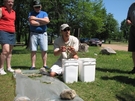
Local volunteers work with our county representatives to gather clarity, temperature, and dissolved oxygen readings in two places throughout the spring and summer months - the deep hole and near the west aerator - every two weeks. Our county representatives enter our data, as they do for other lakes, tracking changes over time to help us understand how these things relate to overall lake health, including but not limited to the presence of algae blooms.
Additionally, we collaborate with the state/DNR to enter data in their SWIMS database (using the same data collected above) and gather/submit test samples once a month from May through August. Two different types of samples are prepared, put on ice and mailed into the state lab for assessment.
These voluntary, but critical, activities help us to make data-driven decisions about how to best care for our lake.
Local volunteers work with our county representatives to gather clarity, temperature, and dissolved oxygen readings in two places throughout the spring and summer months - the deep hole and near the west aerator - every two weeks. Our county representatives enter our data, as they do for other lakes, tracking changes over time to help us understand how these things relate to overall lake health, including but not limited to the presence of algae blooms.
Additionally, we collaborate with the state/DNR to enter data in their SWIMS database (using the same data collected above) and gather/submit test samples once a month from May through August. Two different types of samples are prepared, put on ice and mailed into the state lab for assessment.
These voluntary, but critical, activities help us to make data-driven decisions about how to best care for our lake.
Lake Helen P&RD Actions - Recent Highlights
|
Blue Green Algae Study Grant Approved
Blue Green Algae has been one of the top issues to understand and address for Lake Helen since 2021. In our third attempt, we have been approved for a grant to study the lake, to identify the sources of phosphorus that contribute to BGA growth and serve as a key input to developing a treatment/action plan. |
|
AIS Removal Station - Coming in 2026
The Lake Helen R&P District will be partnering with the Portage County Parks Department to construct a new Aquatic Invasive Species (AIS) Removal Station, complete with new signage and equipment to help local and guest boaters properly clean their boats and trailers prior to and after entering the water to minimize the risk of invasive species transfers. |
|
2025 Chemical Treatment of EWM
Over the summer (2025), the Lake Commissioners worked with location organizations to conduct a chemical treatment aimed at eliminating the invasive presence of Eurasian Water Milfoil (EWM). This type of treatment is done approximately every 5 years, with manual pulling used to address it in between. Hand or manual pulling events in the past have been supported by amazing lake volunteers, and professional divers have been leveraged as needed. |